|
|
Can a Game help a child know where to look on a Face for Clues?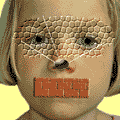
It looks like our FaceSay™ games do, with the help of our unique, patented method of "mapping", "quantifying" and "amplifying" the region around the eyes and eyebrows. In blinded grad student observations in the first randomized controlled study (N=49), students with an Autism Spectrum Disorder who played FaceSay (the intervention) or Tux Paint (the control) were observed on the school playground. The FaceSay students initiated more social interactions, made more eye contact and had fewer negative behaviors. |
|
This generalization to everyday life is a breakthrough for the students and also for the field. For example, in studies of the Transporters DVD, brilliant teams from Cambridge have shown several levels of generalization, but none that involved a real person. This type of success in the lab without success in everyday life is well known in the field. FaceSay's playground results are especially encouraging, because human delivered social skills training also have difficulty achieving more than lab-based success. In a review of 14 studies of social skills interventions for students with an ASD, the authors conclude:
"Further, there is evidence that skills may be displayed in laboratory/clinic settings, but not necessarily applied in the child’s daily life at school or home. Generalization and flexible skill use in natural environments continues to be a challenge"
(read full paper)
What might help a child recognize a classmate's face?What if (s)he could pretend to be the doctor in our "Bandaid Clinic" game, finding and touching the matching facial bandaids to cure a silly disease (see video at right)? What if a classmate could be the animated patient who winks a "Thank you"? How would a visually oriented child respond to an interesting mask and "amplified feature geometry" on a classmate's face? We think children, particularly those who are very visual and love puzzles, might find Bandaid Clinic a fun way to focus on facial features |
|
Can Following a Gaze be Fun?Children (and adults) smile when "Rebecca" - at right - looks around at the objects and says "These DO look fun! Can you touch the one I'm looking at?" (watch a video clip at right). Students start with simply touching a number, move to helping Rebecca get the costume she wants, and then move on to play "Face Tag" with 13 people. The characters use only their eyes, and the child follows their gaze and, with a touch screen, literally "tags" the person who is "it". A bit to our surprise, this is one of the kids' favorites. |
|